





FPGA Implementation of Digital Filters
Digital Filtering algorithms are most commonly implemented using general purpose digital signal processing chips for audio applications, or special purpose digital filtering chips and application-specific integrated circuits (ASICs) for higher rates. This paper describes an approach to the implementation of digital filter algorithms based on field programmable gate arrays (FPGAs). The advantages of the FPGA approach to digital filter implementation include higher sampling rates than are available from traditional DSP chips, lower costs than an ASIC for moderate volume applications, and more flexibility than the alternate approaches. Since many current FPGA architectures are in-system programmable, the configuration of the device may be changed to implement different functionality if required. Our examples illustrate that the FPGA approach is both flexible and provides performance comparable or superior to traditional approaches.
Why You Should be Using Python/MyHDL as Your HDL
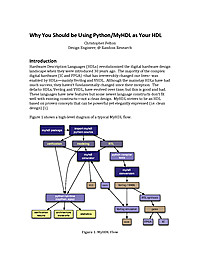
Hardware Description Languages (HDLs) revolutionized the digital hardware design landscape when they were introduced 30 years ago. The majority of the complex digital hardware (IC and FPGA) - that has irreversibly changed our lives - was enabled by HDLs-mainly Verilog and VHDL. Although the mainstay HDLs have had much success, they haven't fundamentally changed since their inception. The defacto HDLs, Verilog and VHDL, have evolved over time, but this is good and bad. These languages have new features but some newer language constructs don't fit well with existing constructs - not a clean design. MyHDL strives to be an HDL based on proven concepts that can be powerful yet elegantly expressed (i.e. clean design)

Numerical Solutions of Differential Equations on FPGA-Enhanced Computers
Conventionally, to speed up scientific or engineering (S&E) computation programs on general-purpose computers, one may elect to use faster CPUs, more memory, systems with more efficient (though complicated) architecture, better software compilers, or even coding with assembly languages. With the emergence of Field Programmable Gate Array (FPGA) based Reconfigurable Computing (RC) technology, numerical scientists and engineers now have another option using FPGA devices as core components to address their computational problems. The hardware-programmable, low-cost, but powerful “FPGA-enhanced computer” has now become an attractive approach for many S&E applications. A new computer architecture model for FPGA-enhanced computer systems and its detailed hardware implementation are proposed for accelerating the solutions of computationally demanding and data intensive numerical PDE problems. New FPGAoptimized algorithms/methods for rapid executions of representative numerical methods such as Finite Difference Methods (FDM) and Finite Element Methods (FEM) are designed, analyzed, and implemented on it. Linear wave equations based on seismic data processing applications are adopted as the targeting PDE problems to demonstrate the effectiveness of this new computer model. Their sustained computational performances are compared with pure software programs operating on commodity CPUbased general-purpose computers. Quantitative analysis is performed from a hierarchical set of aspects as customized/extraordinary computer arithmetic or function units, compact but flexible system architecture and memory hierarchy, and hardwareoptimized numerical algorithms or methods that may be inappropriate for conventional general-purpose computers. The preferable property of in-system hardware reconfigurability of the new system is emphasized aiming at effectively accelerating the execution of complex multi-stage numerical applications. Methodologies for accelerating the targeting PDE problems as well as other numerical PDE problems, such as heat equations and Laplace equations utilizing programmable hardware resources are concluded, which imply the broad usage of the proposed FPGA-enhanced computers.

Memory Reduced and Fast DDS Using FPGA
Direct digital synthesis is a method of creating arbitrary waveforms of desired frequency. A general DDS system comprises analog and digital part. Phase accumulator and LUT make digital part and DAC makes analog part. This paper presents 12 bit memory reduced FPGA based architecture of DDS. Phase truncation and quadrature symmetry of sine wave are used to achieve higher ROM compression. Dither is also used to achieve error free output. This design has been implemented on SPARTAN-3E FPGA with maximum clock frequency of 50 MHz. We have used LTC2624 quad DAC with 12 bit resolution which introduces very less amount of harmonics hence LPF is not needed. This design uses only 128 memory locations. Hence it is suitable for applications where system speed, memory and size of the system are main concern. Its wide and flexible range of frequency make it useful in RF transmission, Biomedical function generators and Modulation.
Numerical Solutions of Differential Equations on FPGA-Enhanced Computers
Conventionally, to speed up scientific or engineering (S&E) computation programs on general-purpose computers, one may elect to use faster CPUs, more memory, systems with more efficient (though complicated) architecture, better software compilers, or even coding with assembly languages. With the emergence of Field Programmable Gate Array (FPGA) based Reconfigurable Computing (RC) technology, numerical scientists and engineers now have another option using FPGA devices as core components to address their computational problems. The hardware-programmable, low-cost, but powerful “FPGA-enhanced computer” has now become an attractive approach for many S&E applications. A new computer architecture model for FPGA-enhanced computer systems and its detailed hardware implementation are proposed for accelerating the solutions of computationally demanding and data intensive numerical PDE problems. New FPGAoptimized algorithms/methods for rapid executions of representative numerical methods such as Finite Difference Methods (FDM) and Finite Element Methods (FEM) are designed, analyzed, and implemented on it. Linear wave equations based on seismic data processing applications are adopted as the targeting PDE problems to demonstrate the effectiveness of this new computer model. Their sustained computational performances are compared with pure software programs operating on commodity CPUbased general-purpose computers. Quantitative analysis is performed from a hierarchical set of aspects as customized/extraordinary computer arithmetic or function units, compact but flexible system architecture and memory hierarchy, and hardwareoptimized numerical algorithms or methods that may be inappropriate for conventional general-purpose computers. The preferable property of in-system hardware reconfigurability of the new system is emphasized aiming at effectively accelerating the execution of complex multi-stage numerical applications. Methodologies for accelerating the targeting PDE problems as well as other numerical PDE problems, such as heat equations and Laplace equations utilizing programmable hardware resources are concluded, which imply the broad usage of the proposed FPGA-enhanced computers.
Memory Reduced and Fast DDS Using FPGA
Direct digital synthesis is a method of creating arbitrary waveforms of desired frequency. A general DDS system comprises analog and digital part. Phase accumulator and LUT make digital part and DAC makes analog part. This paper presents 12 bit memory reduced FPGA based architecture of DDS. Phase truncation and quadrature symmetry of sine wave are used to achieve higher ROM compression. Dither is also used to achieve error free output. This design has been implemented on SPARTAN-3E FPGA with maximum clock frequency of 50 MHz. We have used LTC2624 quad DAC with 12 bit resolution which introduces very less amount of harmonics hence LPF is not needed. This design uses only 128 memory locations. Hence it is suitable for applications where system speed, memory and size of the system are main concern. Its wide and flexible range of frequency make it useful in RF transmission, Biomedical function generators and Modulation.